

Every bone tells you something
Posted by PelletPal Team on Oct 16th 2026
This article first appeared on pelletpal.net/learn, where it has an interactive kid-friendly version.
How to move from "I found a skull" to "I know which species this was". Teeth name the species, femurs reveal age, and rib counts betray a second animal in the same pellet. A short field guide to reading your own tray.
Start with the jaw, not the skull
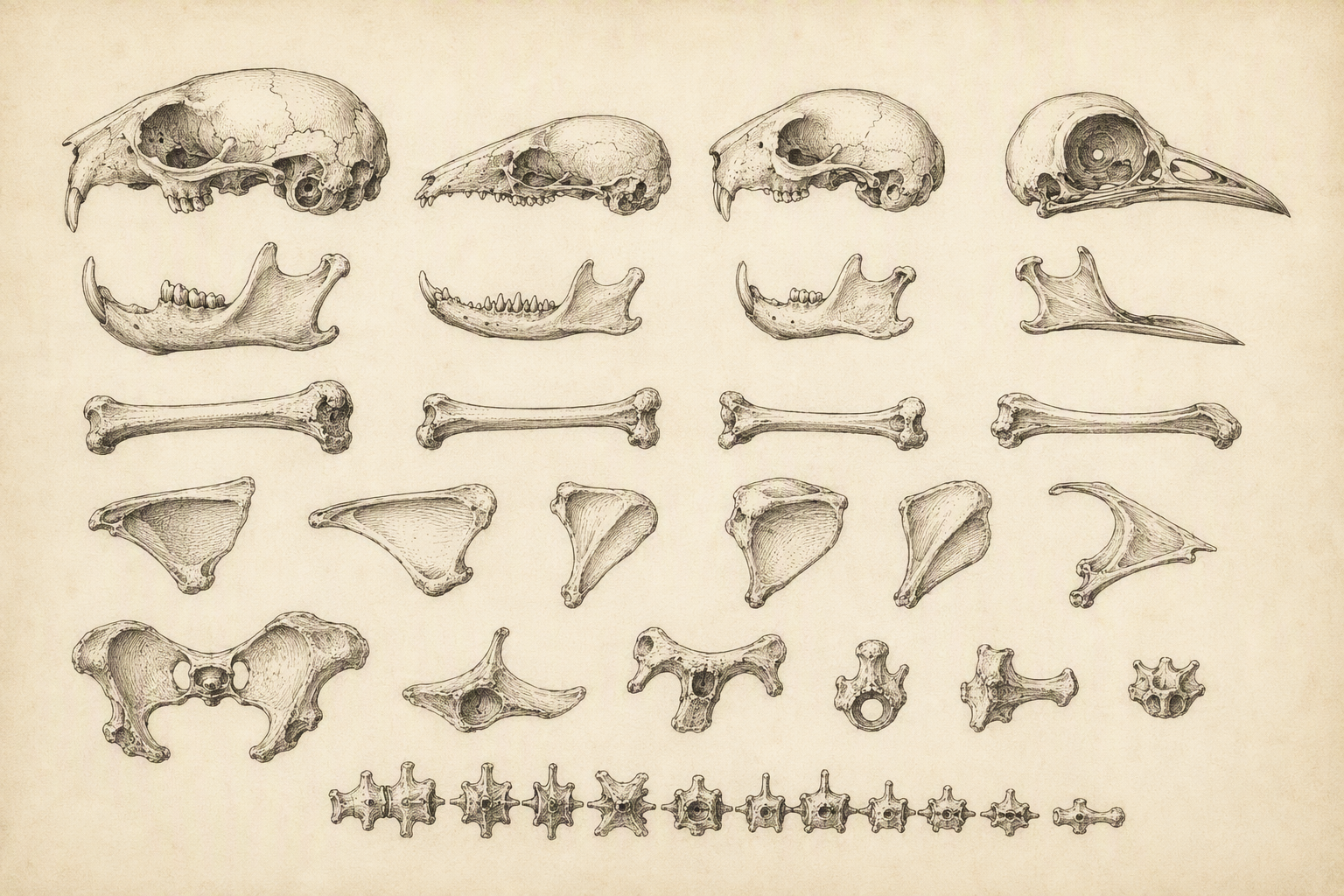
Skulls are the trophy, but jaws are the workhorse. There are two per animal, they separate cleanly during digestion, and they carry a full tooth row. Counting jaws is also the standard way to count prey: divide the number of lower jaws by two and you have your minimum number of individuals — far more reliable than counting fragile skulls.
For younger readers: Jaws are the easiest bone to find and the easiest to identify. Look for the teeth.
Teeth name the species
Vole molars present flat grinding surfaces with a distinctive zig-zag enamel pattern, suited to abrasive grass. Mice show cusped, bumpier molars and a longer snout with a larger eye socket, matching a mixed diet of seeds and insects. Shrews are unmistakable: a continuous row of fine needle-sharp teeth, frequently stained rust-red at the tips by iron in the enamel. Moles have robust jaws and heavy shovel-like forelimb bones. Any skull with a beak and no teeth at all is a bird.
For younger readers: Flat zig-zag teeth mean a vole. Pointy teeth with bumps mean a mouse. Tiny needle teeth mean a shrew.
Femurs reveal age
Femur length is a serviceable proxy for age and body size. Measure every femur in your tray in millimetres and plot them: a cluster of short bones alongside a cluster of long ones indicates the owl was taking both juveniles and adults, which usually points to a breeding-season prey population. Juvenile bones are also more porous and slightly translucent at the ends where growth plates had not yet fused.
For younger readers: Line up all the leg bones. Short ones are young animals, long ones are grown-ups.
When the numbers do not add up
Count skulls, jaws, pelvises and femurs and compare. Three femurs and one skull is normal — small bones are lost — but two skulls or more than about thirty ribs indicates multiple prey in a single pellet. Barn owls commonly take two or three animals before casting. Recording the minimum number of individuals per pellet, rather than simply cataloguing species, is what turns a dissection into usable data.
For younger readers: Two skulls in one pellet means the owl ate twice before coughing up. Count carefully!
Keeping your specimens
Rinse finds gently in cool water, drain them on paper towel and let them air dry for at least twenty-four hours before storing — bone sealed while damp will mould. Store in labelled paper envelopes or small boxes, never sealed plastic. Record the date, the pellet number and the identification on the outside. Mounted on card with labels, a set of bones from one pellet makes a display that is genuinely museum-like, and a class set assembled over several years becomes a real reference collection.
For younger readers: Rinse the bones, dry them on paper for a day, then keep them in a labelled envelope.
Key takeaways
- Count lower jaws and halve the total for minimum prey number.
- Tooth shape is the definitive species clue.
- Femur length separates juveniles from adults.
- Dry bones fully for 24 hours before storing them in paper.
Try it yourself with a Pack of 5 or, for a class, the Pack of 20.