

Built for silence
Posted by PelletPal Team on Oct 16th 2026
This article first appeared on pelletpal.net/learn, where it has an interactive kid-friendly version.
How a barn owl hears a vole under snow and reaches it without a sound. That heart-shaped face is a parabolic dish, the ears are deliberately mismatched, and the wing feathers are engineered to erase the sound of flight. Every part of it points at one job.
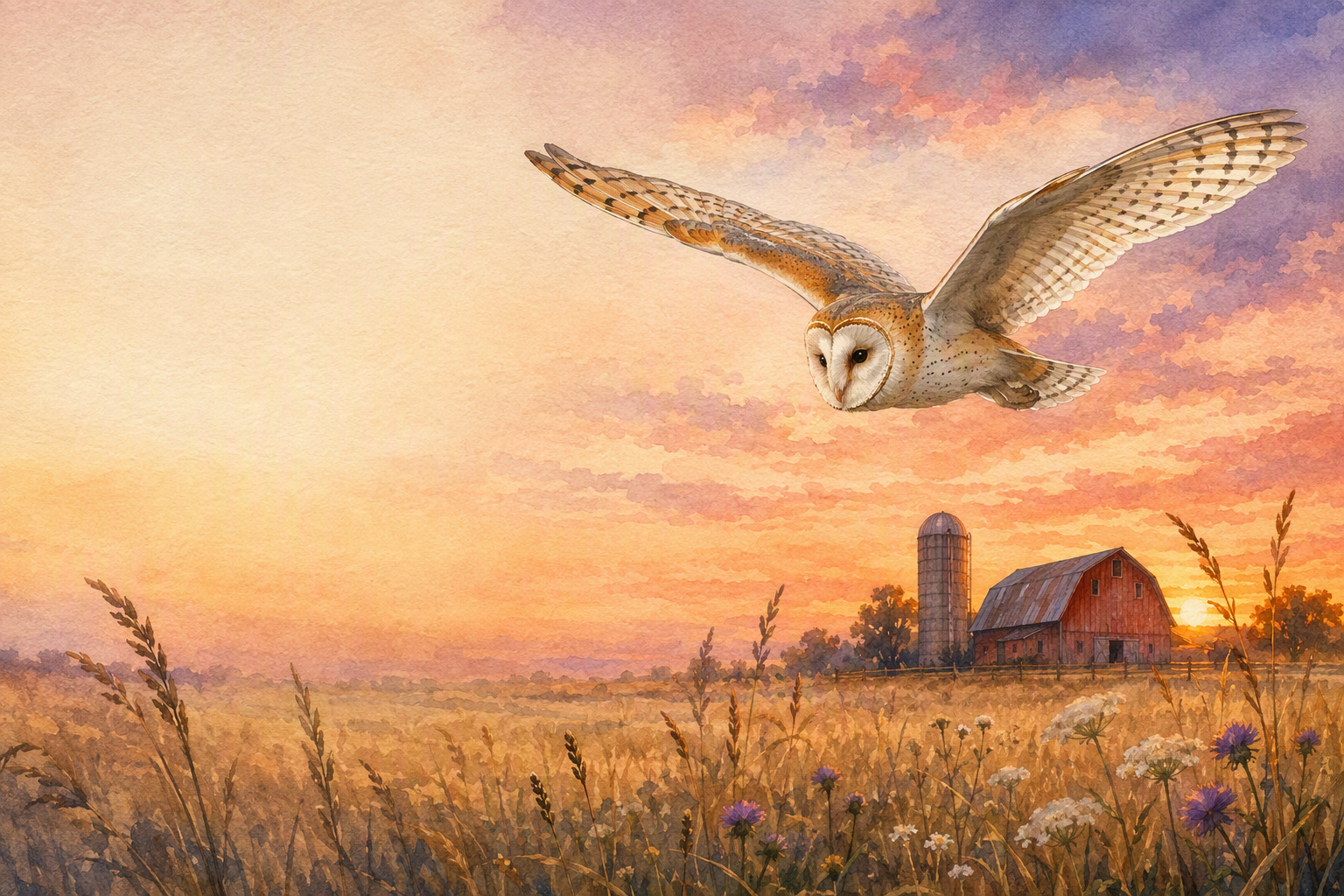
A face shaped like a satellite dish
The barn owl’s facial ruff is a sound collector. Stiff feathers form a shallow parabola that gathers faint sound and channels it toward ear openings hidden at the edges of the face. Cup your hands behind your own ears and you have built a crude version. It works well enough that a barn owl can locate and catch a rodent in complete darkness using hearing alone.
For younger readers: The white heart-shaped face funnels sound to the owl’s ears, like cupping your hands behind them.
Ears that disagree on purpose
The two ear openings are set at different heights and angles — asymmetry that is deliberate rather than a flaw. A sound arriving from below reaches the lower ear a fraction earlier and slightly louder. The owl’s brain reads that mismatch as elevation, while left-right timing gives bearing. Combined, the two produce a genuine three-dimensional fix on a rustle in the grass, accurate enough to strike prey moving beneath snow.
For younger readers: One ear points slightly down and the other slightly up, so the owl can tell height as well as direction.
Feathers that erase noise
Three features work together. A comb-like fringe on the leading edge breaks the airflow into fine streams before it can form noisy turbulence. A soft, porous trailing edge lets those streams rejoin gently instead of snapping together. And a velvety upper surface absorbs the remaining high-frequency hiss. The result damps exactly the frequency band a rodent listens for. The owl gains a double advantage: prey cannot hear it coming, and the owl’s own hearing is not masked by the noise of its own wings.
For younger readers: The front edge of the wing is fringed like a comb, and the surface is velvety, so the air does not whoosh.
The trade-off
Silence has a cost. The porous, velvety feathering that kills noise also fails to shed water, so a barn owl in sustained rain becomes waterlogged and cannot hunt. Add the species’ small fat reserves and you get a bird with very little margin: a prolonged wet spell or a hard snow crust that muffles prey sounds can be lethal. Every specialist trades flexibility for excellence at one job.
For younger readers: Soft, quiet feathers are not waterproof, so barn owls really struggle in long rain.
Key takeaways
- The heart-shaped face is a sound-gathering dish.
- Asymmetric ears let the owl judge height as well as direction.
- Fringed, velvety feathers erase the sound of flight.
- Quiet feathers are not waterproof — rain grounds barn owls.
Try it yourself with a Pack of 5 or, for a class, the Pack of 20.