
How a pellet is made
Posted by PelletPal Team on Oct 16th 2026
This article first appeared on pelletpal.net/learn, where it has an interactive kid-friendly version.
From swallow to specimen in about twenty hours. A barn owl cannot chew and cannot digest bone. Follow one vole through two stomachs and find out why the result lands in your dissection tray almost perfectly preserved.
Swallowed whole
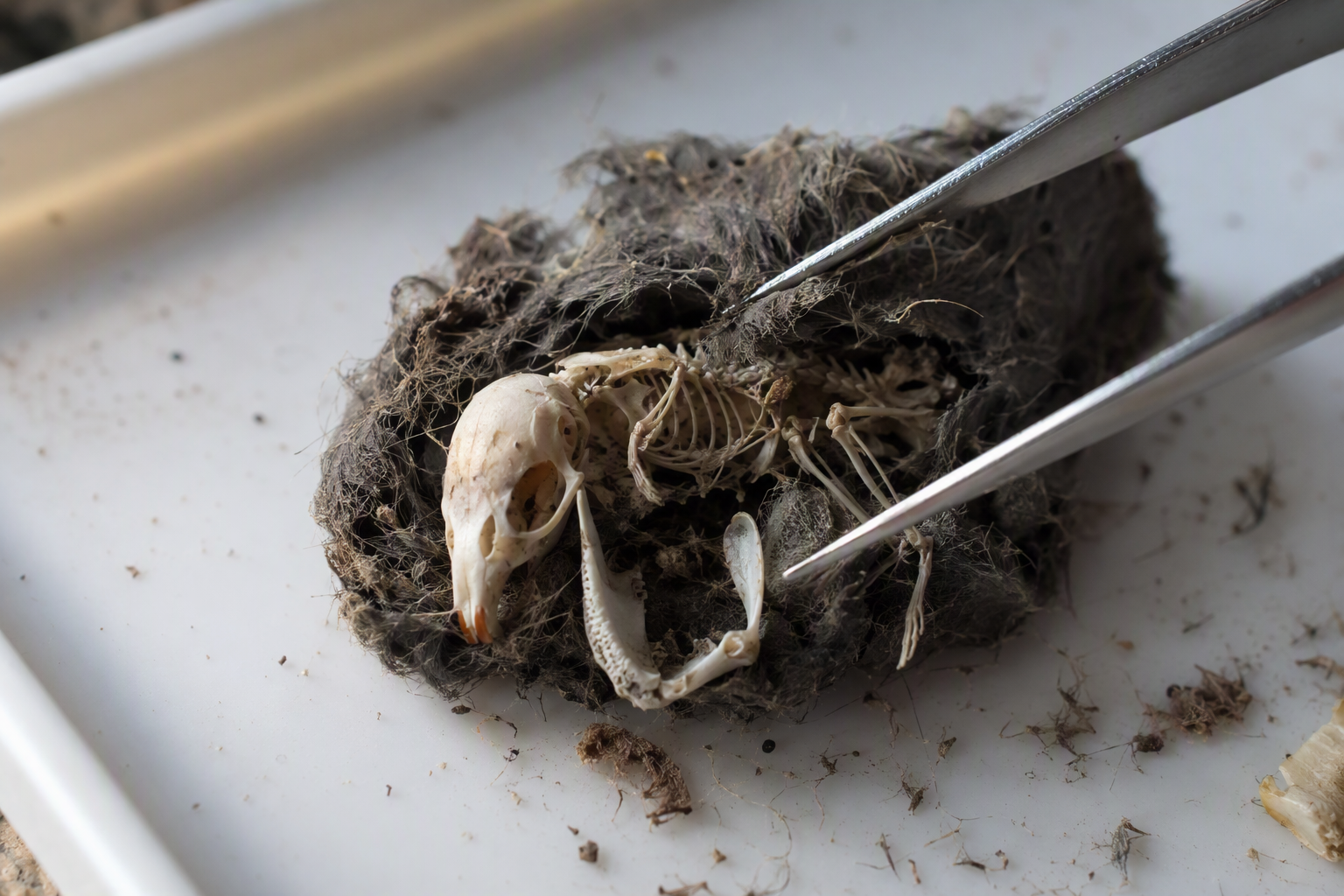
Barn owls have no teeth and a beak built for gripping rather than grinding, so prey goes down whole and usually head first. A vole the length of your thumb disappears in a couple of swallows. Because nothing is chewed, every bone enters the owl unbroken, which is the single reason pellet dissection works as a science lesson at all.
For younger readers: Owls have no teeth, so they cannot chew. An owl swallows a vole in one gulp — head first, tail last.
Two stomachs, one job each
Food arrives in the glandular stomach, where acid and enzymes strip away muscle and organs. It then meets the gizzard, a muscular sorting chamber. The gizzard is the clever part: it lets softened tissue pass through to the intestine while holding back everything indigestible. Barn owl stomach acid is comparatively weak, so bone comes through this stage far better preserved than in a hawk, which digests most of the skeleton away.
For younger readers: The first stomach squeezes and sorts. The soft parts move on to be digested. The bones and fur stay behind.
Packing the pellet
The gizzard compacts the rejected fur, feathers, teeth and bone into a tight, felted mass. Fur ends up on the outside and bone toward the centre — a genuinely protective arrangement that stops sharp edges injuring the throat on the way back up. The finished pellet is typically 1.5 to 2.5 inches long and holds the remains of one to four prey animals.
For younger readers: The leftover fur gets squeezed around the bones like bubble wrap, making a neat grey lump.
Coughing it back up
Roughly ten to twenty hours after eating, the owl stretches its neck, opens its beak and expels the pellet — a process called casting. An owl generally cannot swallow a fresh meal until the previous pellet has been cast, so casting rate is a rough measure of feeding rate. Most barn owls produce one or two pellets a day, and because they return to the same roost, decades of pellets can pile up beneath a favoured beam.
For younger readers: About a day later the owl stretches its neck and coughs the pellet out. It does not hurt.
Why scientists care
A pellet is an unusually honest survey of the small mammals in an area. Live-trapping is expensive, biased toward bold animals and stressful for the animals caught. Pellets cost nothing, harm nothing, and accumulate on their own. Researchers have used pellet records to detect shrew species previously unrecorded in a county, to track rodent population cycles across decades, and to measure how farm management changes the small-mammal community. When you count jaws in your tray, you are running the same method.
For younger readers: The bones inside are a list of what the owl ate. Counting them tells us which animals live nearby.
Key takeaways
- No teeth means no chewing — which is why the bones survive intact.
- The gizzard sorts digestible from indigestible material.
- One pellet can hold one to four prey animals.
- Casting takes about ten to twenty hours after a meal.
Try it yourself with a Pack of 5 or, for a class, the Pack of 20.